

Decluttering Advice for Artists
It's not easy, it's not pretty but it is worth it

I see you, artist. Eyes wide. A guilty look on your face. Mildly panic stricken at reading the word declutter. Maybe even an unpleasant feeling in your stomach. Because you’ve got stuff. Lots of stuff. And every now and then you think you really should sort it out. But you don’t. Because it has come to feel like a mammoth task. Because you don’t know where to start. Because there are always ‘more important’ things to do. Maybe like me you’re easily overwhelmed and the thought of it is just too much. Or (most likely) you simply cannot get rid of your stuff because… ready for it?… and I quote (every artist who ever lived. Except the one who destroyed all his belongings) “It might come in useful”
We’ll get back to that.
Let’s get this straight though - I did not write this so you could turn it into a big stick to beat yourself with. So put that stick down. Right now! I also did not write this so you could turn it into a big stick to beat me with. We all have different relationships with our belongings and creativity. I know there will be those who feel most comfortable surrounded by stuff and reject everything I say below. Thats ok. I didn't write this for you. I wrote it for folks who, like me, suspect their clutter might be holding them back but also don’t know where to start.
Either way - proceed with kindness.
Why decluttering?
First let me briefly explain why I’m writing on this subject.
I’m no Marie Kondo devotee (haven’t actually read it) and I’m no better than the rest of us when it comes to collecting crap. However, over the years I’ve noticed that decluttering is an essential part of my creative practice. Ask anyone who has shared a studio space with me for any length of time and they will tell you - I reliably, regularly have ‘a big clear out’. So far, so what? But the thing is, during these clear outs I always glean big, juicy insights. Creative insights. And who doesn’t want more of those!?
Clearly, this could be a part of my unique way of thinking/working. Except that it makes perfect sense. The decision making involved in decluttering as a creative is all about your practice - your past, present and future. Your hopes and dreams. What you value. What you used to value. Where you see yourself going. This is the process by which I step back and review what I’m doing. Make sense of the paths I’ve taken and the ones I want to take. I need a physical process to help this thinking. It feels very muddy and abstract without it. I need to move, touch, weigh things up - literally - and see how things take up space. My space.
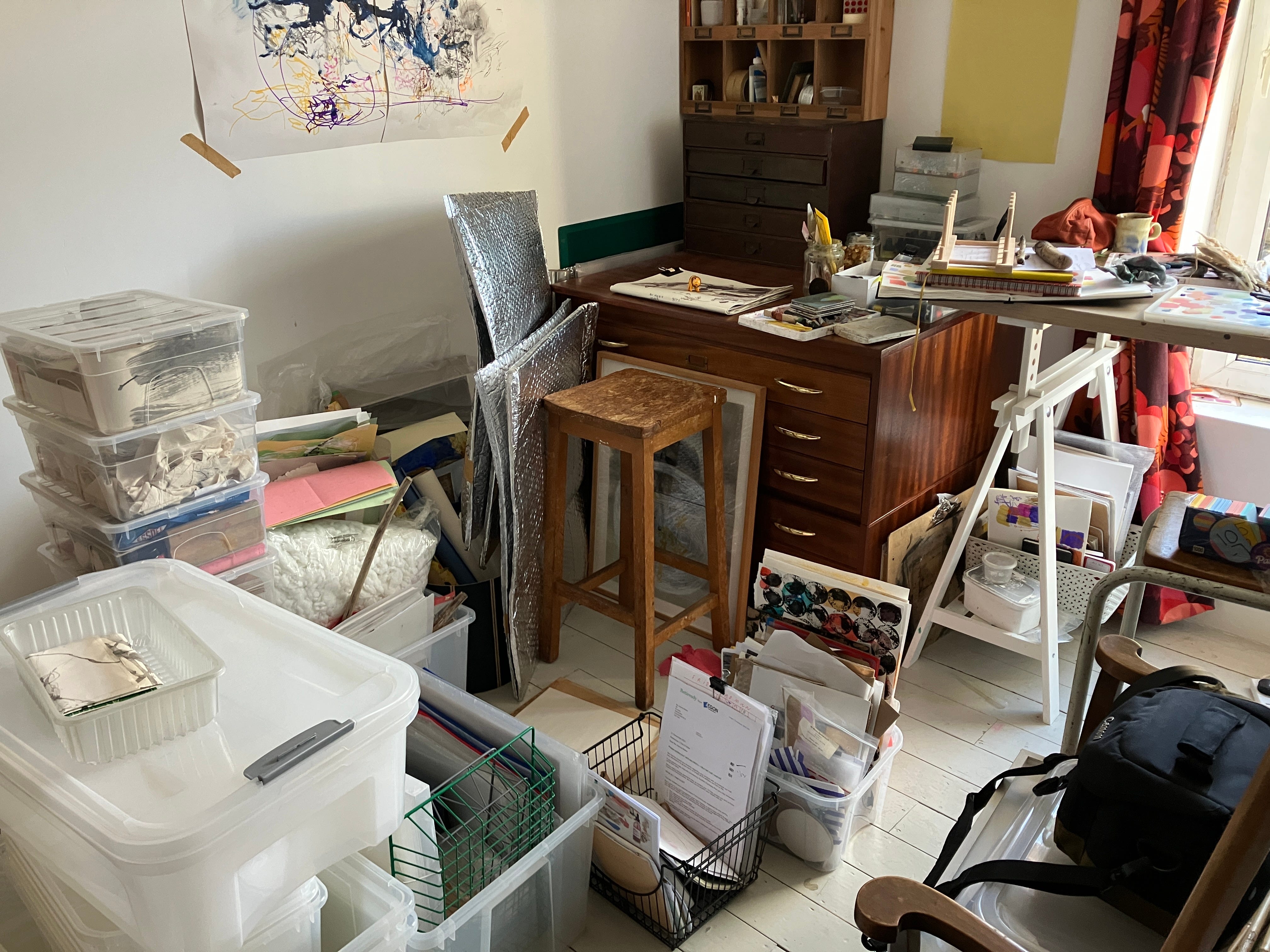
Clearly, decluttering is of significance to me. But I’m also sharing because it provokes a reaction like no other when I share content on this subject on other platforms. Every time I am inundated with messages. Decluttering provokes a reaction unlike anything else I share. This confirms what I already knew - artists are acquisitive. We collect. Stuff. And we hate to part with it. So we don’t. And I know how stuff can weigh you down.
Side note - I used to love the moment a kid would wander into my workshops at the art gallery clutching sticks, leaves, feathers, stones etc. Adults would sometimes apologise. To which I happily explained that its an artist thing, and that I have special sticks and feathers and skulls and hey - I’ve even collected sheep poo before…
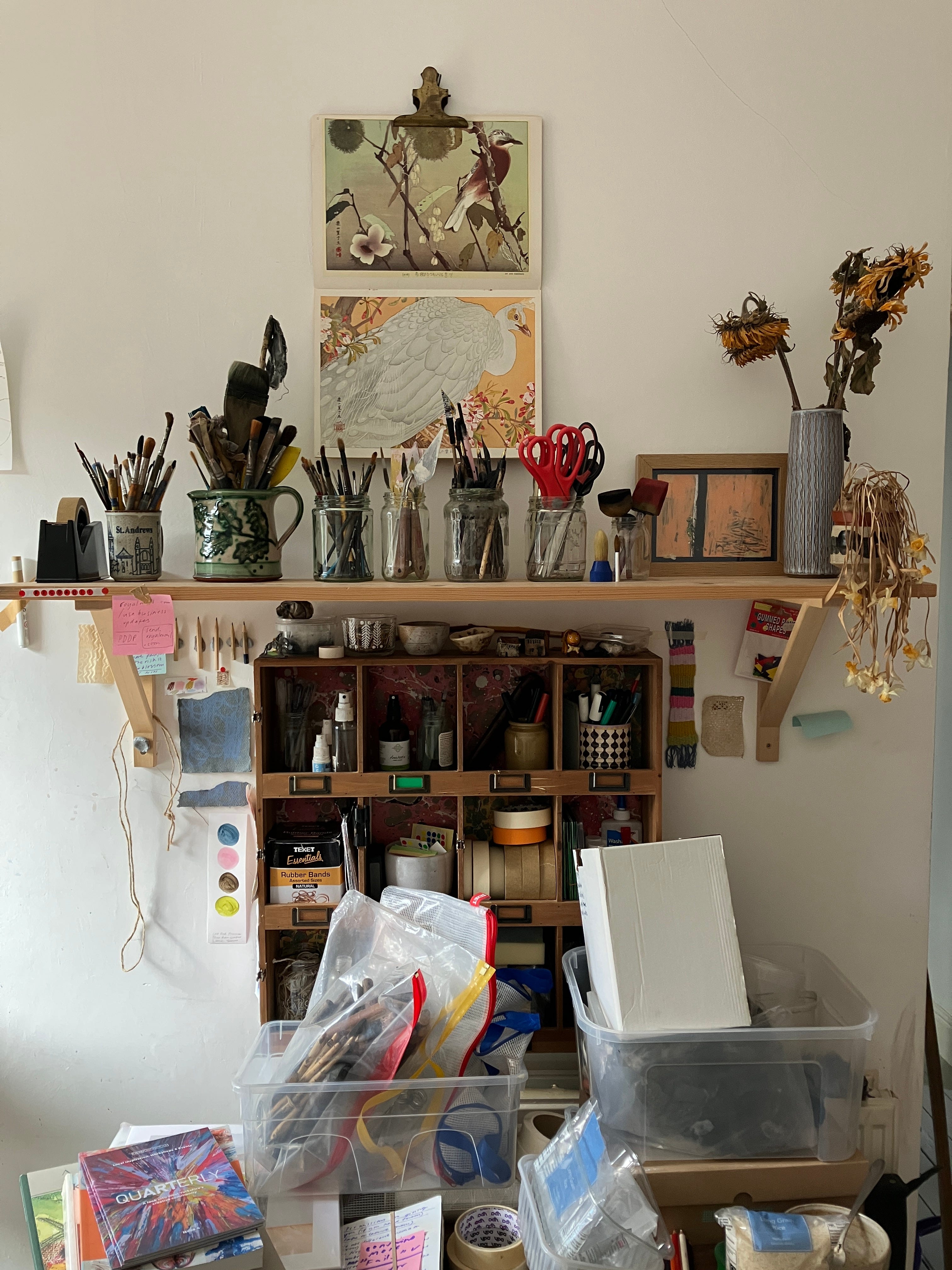
A blessing and a curse
The reason we hate to part with stuff is one of the biggest reasons we need to declutter, in my experience. It is about feelings and about our wonderful, wonderful ability to see the potential in things. And in all manner of things. Especially if we make work from found objects or share our creativity with others through teaching, community work, workshops etc. This kind of work is a carte blanche to collect huge quantities of junk (said with love - I’ve been there, collected that).
This ability to see the potential in things, means sometimes, when we look at a bag of (say) scrap textile - we don’t see the material itself, we see the unrealised project. The unfulfilled creativity. We see that great idea we just haven’t had time, funds, space etc to realise. Or maybe we see multiple possibilities. And if we look around our space and see unrealised ideas everywhere - it gets to us. Honestly, every artist I’ve spoken to about this gets the same slightly sad look on their face at this point in the conversation. It is all too easy to draw negative conclusions about ourselves, our practice, our artistic merit when we see unrealised ideas all around us.
One artist I chatted to about this recently even admitted, half of those ideas she didn’t actually really want to make!
If we don’t get into the habit of confronting our stuff and the unrealised projects it represents, over the years our spaces become full. Full of stuff. But full of emotional baggage too. And that I believe, will hamper you creatively.
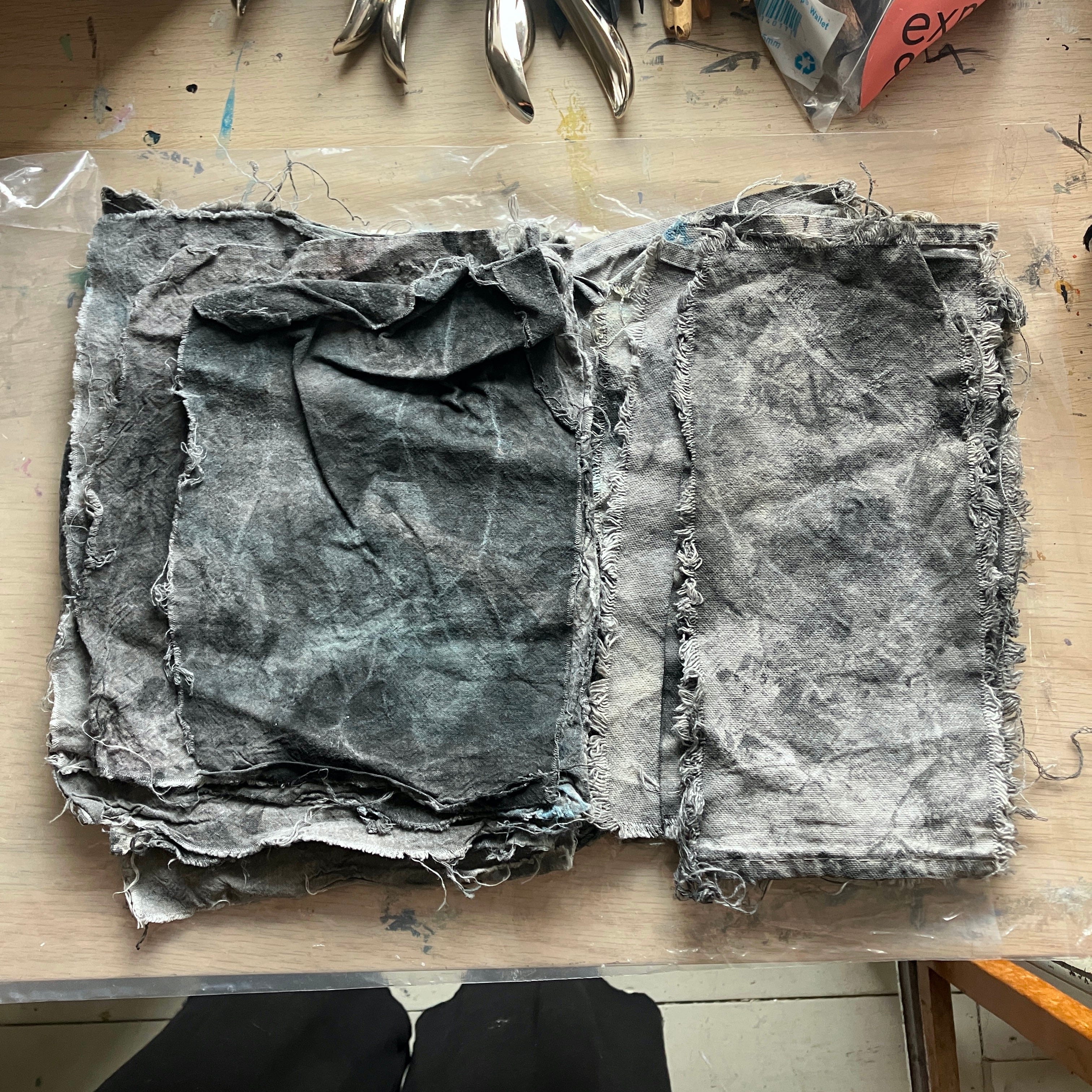
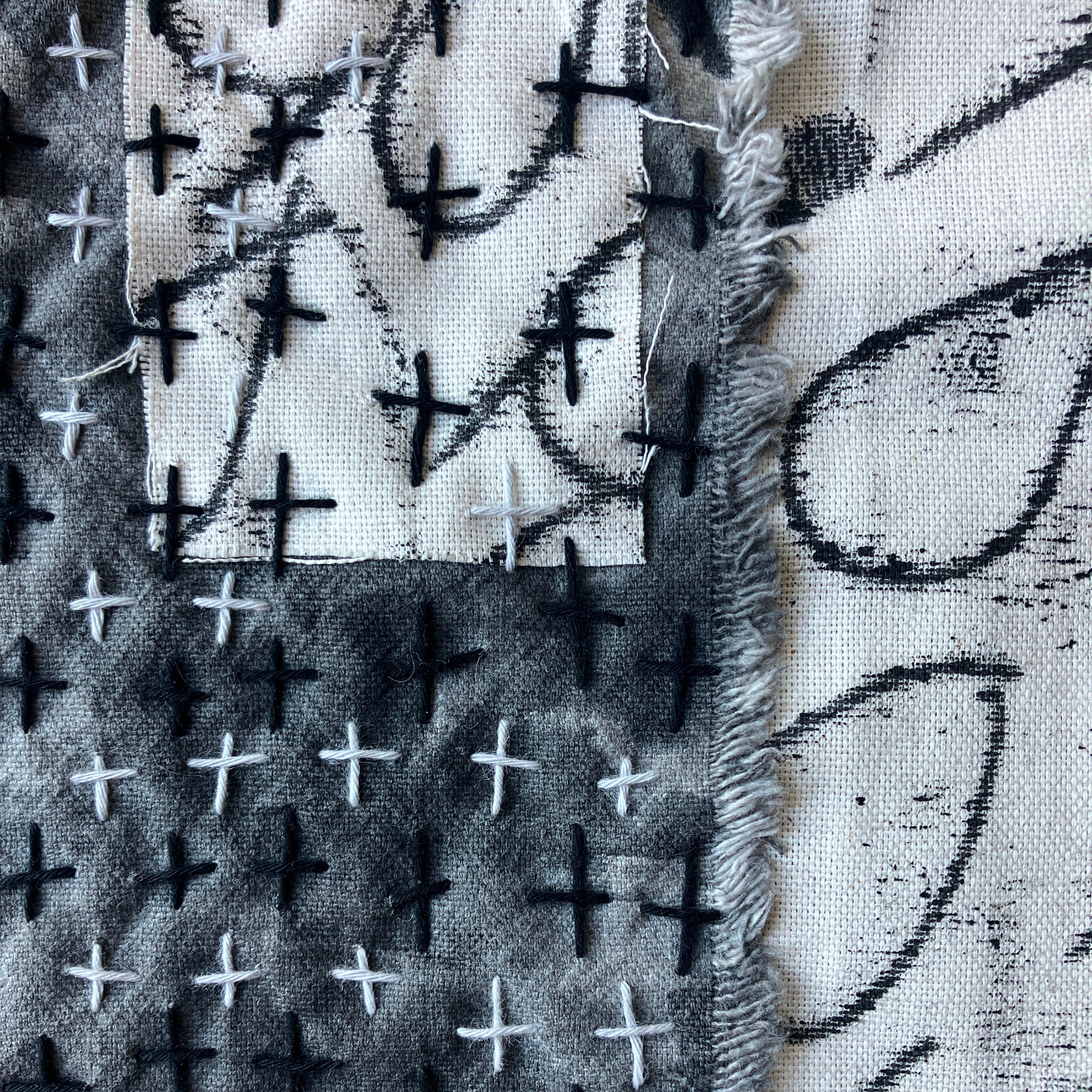
For this reason, decluttering is a big process. It is an emotional process. But I want you to know you’re not alone in having these feelings. We’ve all got half finished projects, equipment or materials we didn’t even get out of the box and stuff we just don’t know what to do with. The things you’ve held onto might bring up feelings of sadness or grief, for unrealised dreams. This is normal. Our creative brains love to dream. Sometimes in many directions. More directions than it is possible to travel in. Life forces us to choose. We get swept along and our dreams get pushed to the back of the cupboard. But decluttering can throw up memories, objects, work you’d entirely forgotten about. It can lead to creative sparks - like my inky rags and patchwork clouds (see below).
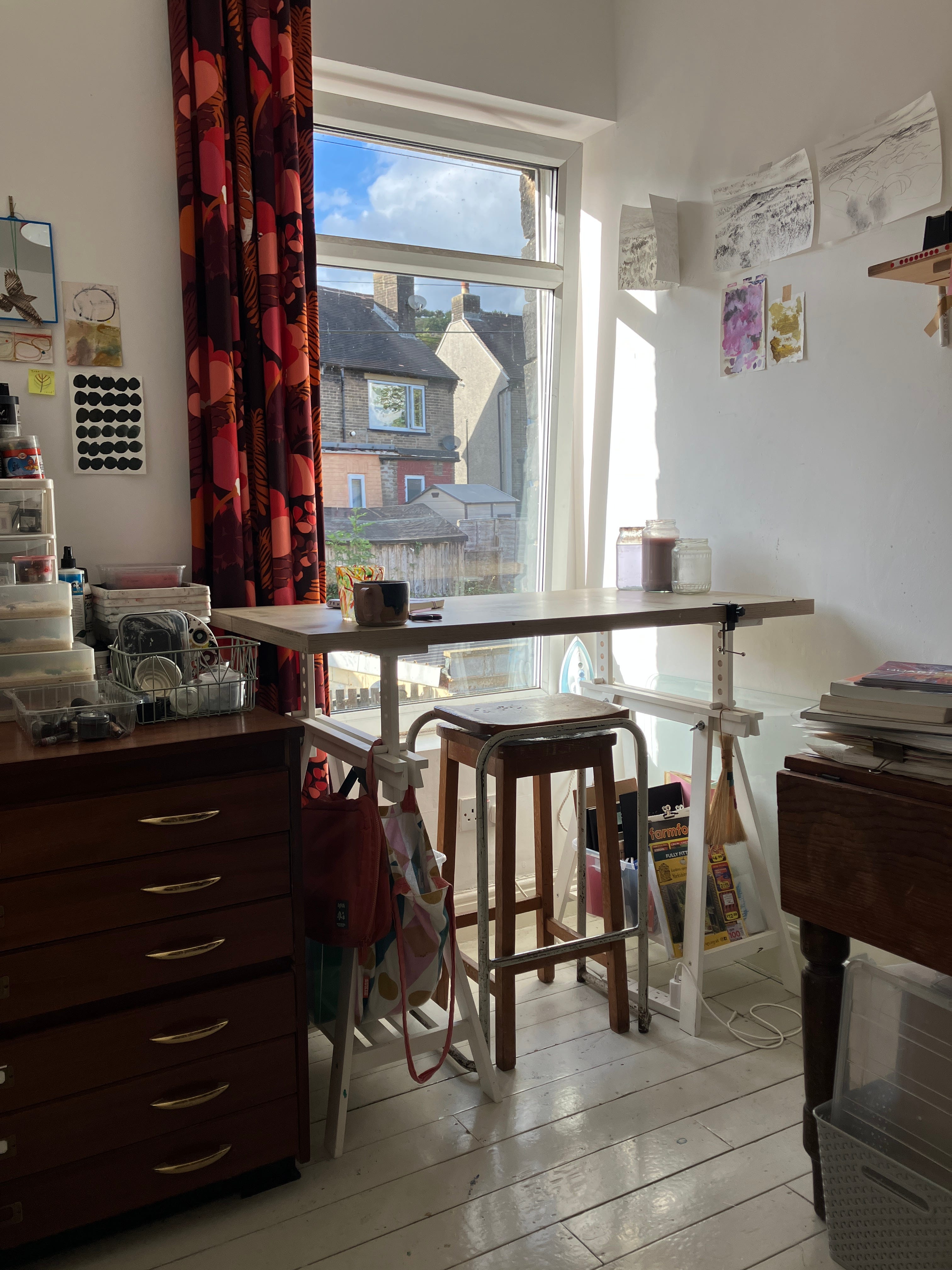
In 2024 I looked around me and realised my studio space was dominated by the work I do with others - my teaching work. When I looked around I didn’t ‘see’ my personal creative practice in my space. I recognised it was necessary for me to ‘reclaim’ my space and give myself permission to put my own creative practice first. And I’ve not looked back.
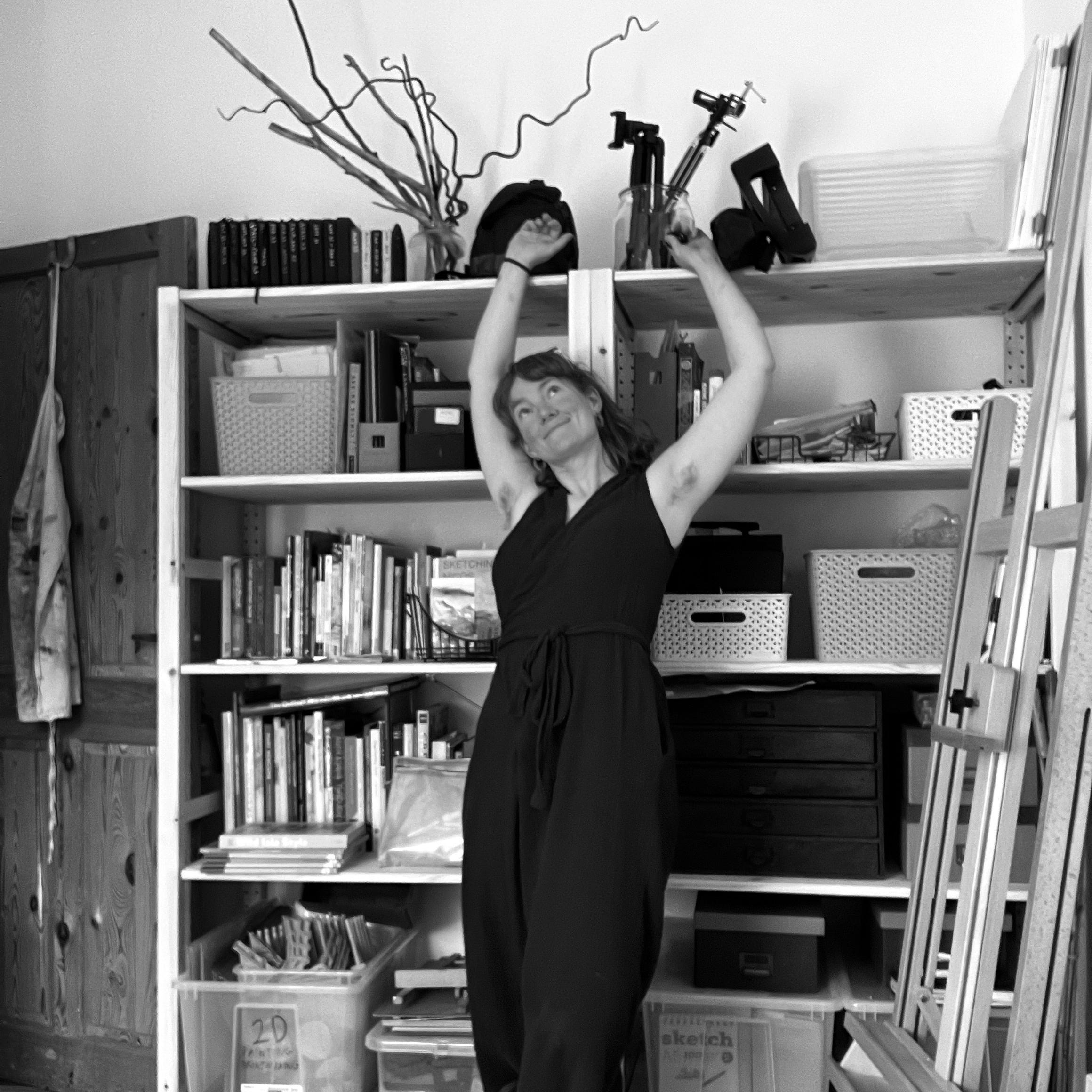
Tips - You’re not alone
Given the enormity of what you could be facing - please, speak to a professional if the challenge is not one you feel able to face alone. Or recruit help from trusted folk around you.
Put shame in the bin. Seek out groups, professionals, programs or podcasts that deal with this subject. Those aimed at creatives are especially helpful. It will really make a difference if you can realise that you are not alone, and that this is a widespread issue other people struggle with. Deciding you’re ready to tackle this challenge is not something to feel ashamed about. It is a positive step to be proud of.
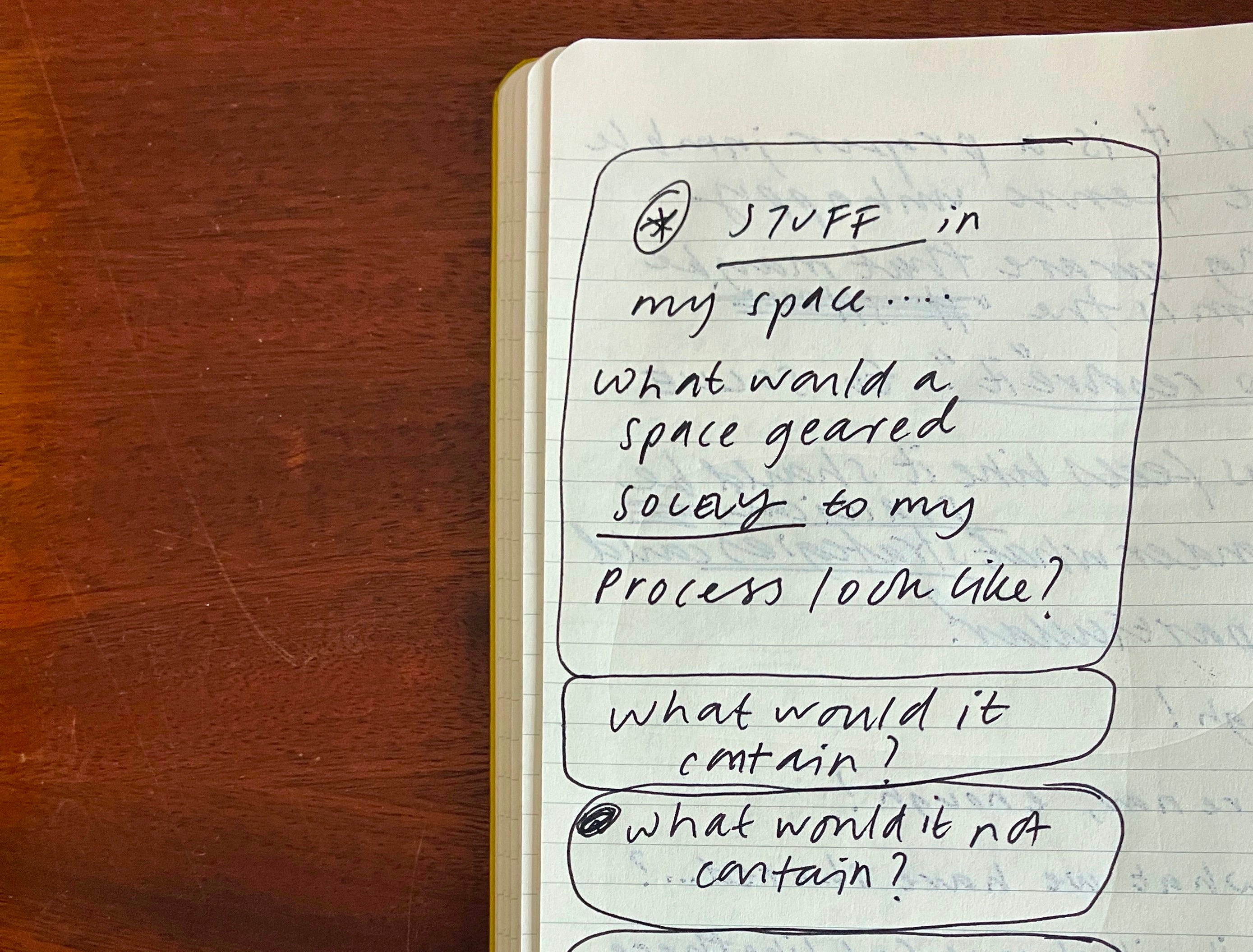
You don’t even have to start with decluttering to begin. I’ve suggested some creative/journal prompts at the bottom of this article, incase a gentle start feels more manageable.
Tips - Mindset
Give it time This is a time consuming thing to do. The sorting takes time, the rehoming takes time. It may well be an ongoing project that you work on over a period of time…
Choose your timing Each item requires a decision. Some more emotional than others. If you can choose when to embark on this be kind to yourself by starting when you have enough mental, physical and emotional capacity for it.
A space first approach - What would you rather have? Stuff or space? I am forced into decluttering by my love of space and a need for spaciousness. (Even in a box room!) My hunch is that we have a ‘stuff’ focus rather than a ‘space’ focus. We try to make our stuff fit our space and complain about lack of space when it doesn’t. But what if we flipped it and created limits for ourselves based on the available space? If we made decisions on what to allow in, based on some sort of space:value ratio.
Future Focus I found it helpful to ask myself - Does this relate to where I want to go? Lets say I see the potential for certain materials in particular workshops, but if running these workshops is not in my plan or notion of where I’d like to go - whats the point?! Which brings us onto the question…
Who are you keeping this for? Sometimes we find ourselves holding onto things to protect the feelings of others. Sometimes, those ‘others’ aren’t even alive any more. With sensitivity we can find ways to safely relinquish any sense of responsibility we might feel we no longer need to carry
Don’t throw the baby out… Let’s channel William Morris here for a second. It’s really important to know what matters to you and your creativity. Because stuff that looks like junk might be really important to your process. You don’t have to get rid of beautiful things simply because their sole function is that they inspire you. No no. Thats the last thing I want. What we’re aiming for is cutting away all the superfluous stuff so we can really see, find (!) and enjoy the significant stuff. The things that light you up, help you feel motivated etc.
See below for practical strategies to help with this.
Tips - Practical Strategies
Start small. Choose a drawer, a box, a shelf. If that feels good maybe you’ll feel up to tackling another drawer/box/shelf and so on.
5, not 50 You don’t have to chuck out everything - sometimes it can help to gather belongings by group. To help you see what you have. A la Sort Your Life Out. And then, as they do on SYLO - assess how many you realistically need or have space for. And you rehome, donate, recycle, or dispose of the rest.
Tidying, Organising and Cleaning are 3 different tasks - I heard this on an episode of this podcast years ago. Whilst not strictly about decluttering, these tasks overlap with it, so I thought it was worth a mention. Folks with ADHD are especially prone to trying to accomplish all these tasks at once, getting overwhelmed and abandoning the process altogether. Choose one and be kind to yourself if/when you drift into old habits and start organising when you should be cleaning.
Like or Love? For me, in my personal space as well as my studio space its helpful to make the distinction between what I LIKE and what I LOVE. I only really have space for the latter. My space impacts my ability to create. Let’s treat it with some reverence.
Tips - Questions to tackle “It Might Come in Useful”
How long have you had it? How many years? How many decades? How many house moves, births, deaths, marriages have you had this thing sitting awaiting its destiny of one day ‘coming in useful’?
Are any likely opportunities to use it on the horizon?
If an opportunity arose where it ‘might come is useful’ would you actually want to do it?
In this time how many times (if at all) has it actually come in useful? How about we establish some sort of ‘expiry date’ system? Only you can decide what your cut off point is - but lets say it should probably be under a decade ;-) If it has passed this cut off point thank it for its service and show it the door
Could the space it is taking up be better used?
Could you source it again if you really needed to?
Maybe it could come in useful. For someone else. I suspect your creative heart will find materials easier to let go if you know they will be used and appreciated by someone else. For that (and other reasons) I recommend rehoming everything usable where you can. Schools and community groups may welcome donations. Try online ‘free cycle’ style groups. Have a jumble sale or attend a car boot. My scrap paper stash regularly gets turned into collage paper packs that I sell online and I get a lot of joy out of assembling these.
Thanks grandad
My grandad lived through the war. So maybe I shouldn’t give him a hard time about having had a whole drawer full of string. I loved it in fact. That's the problem. There are certain things I feel hard wired to hoard, having been raised by people who were raised by people who developed a scarcity mindset as a result of traumatic times. Fair enough really. But times have changed. And things that were precious in my childhood (colourful paper, lollypop sticks, egg cartons) are now readily available.
Here’s a list of things I struggle to readily let go of:
String - used, unused, knotted, unknotted, tiny lengths, huge lengths - its all going in my string jar. Ok, jars.
Board - grey board, picture mounting board, corrugated board. As I type I’m eyeing up a box of scraps that I haven’t touched since that big declutter over 12 months ago. I already gave away a massive bag. Yet here it is. Time to apply my own advice!
Transparent plastic containers with lids - I mean, obviously these are worth their weight in gold? Bcs obviously there’s a scarcity of plastic containers in the world right now isn’t there? No. There is not.
Bubble wrap - I never seem to have it when I need it… and I sort of resent buying it. Like there should be enough of it in circulation that no one need ever buy it ever again. Same with biros and pencils.
Scrap paper - good lord this one is probably the hardest to break
But what if?
It is true. On occasion I have regretted no longer owning a certain item. Or book (its usually books). But my heart didn’t break, the world didn’t end, life was not made unliveable. I coped. This is the risk you have to take. Trust that you will cope.
Creative / Journal Prompts
Here are some suggestions if you like the idea of employing your creativity to help you on this mission. But - do not buy or otherwise acquire any stuff in order to complete this task ! ;-)
With words, images, textures, smells, sounds - whatever works for you - think about the space you want to create. What would it contain? What would it not contain? How would it feel? What could it help you do differently?
Write about a space or place that has supported you creatively. Connect with the memory of how that felt. Remember as much detail as you can about the space and the stuff in the space. What aspect (however small) of that space could you bring into your space today?
Thats all for now
I could say more - but I’m running out of space :-)
Don’t forget to celebrate your wins if you take action! If you have any tips please do share. If you have any questions - I’ll try my best.
Thanks for reading,
Jo
This is something I have been thinking about a lot recently. I moved spaces and there is so much stuff, most of it stuffed into drawers and it has moved to the point where it is overwhelming. And I don't want to die and leave all my clutter to my family
I have started putting things I have made that I like on the walls rather than sticking them in boxes where even I don't see them.
I've managed to pass materials onto other people, downsized a bit but it feels like a drop in the ocean of things.
Going through all the boxes of work I feel like I have learned about the paintings I love and the ones I hang onto out of a sense of not throwing it away. Still so much to do in sorting through everything I have though.
Useful advice but so difficult! I changed direction from mosaic to printmaking and thought I'd have less stuff once I'd got rid of my mosaic stuff. Who was I kidding? Not only do I still have masses of mosaic tiles I'm still trying to sell (they are the expensive Italian type) but I now have half of Dartmoor, (bracken, feathers, stones, sticks, sheeps wool, acorns etc) , hand made papers, jars of hand made inks, paints, books, card, frames, rollers, and masses of old prints and 'clean up' mono prints, that I occasionally cut up to use in collages. It's never ending and while it's nice to be buried in Dartmoor, my studio is getting smaller and smaller, whilst I find myself more and more cramped! Ugh! I think it's time for a tidy up don't you? :D